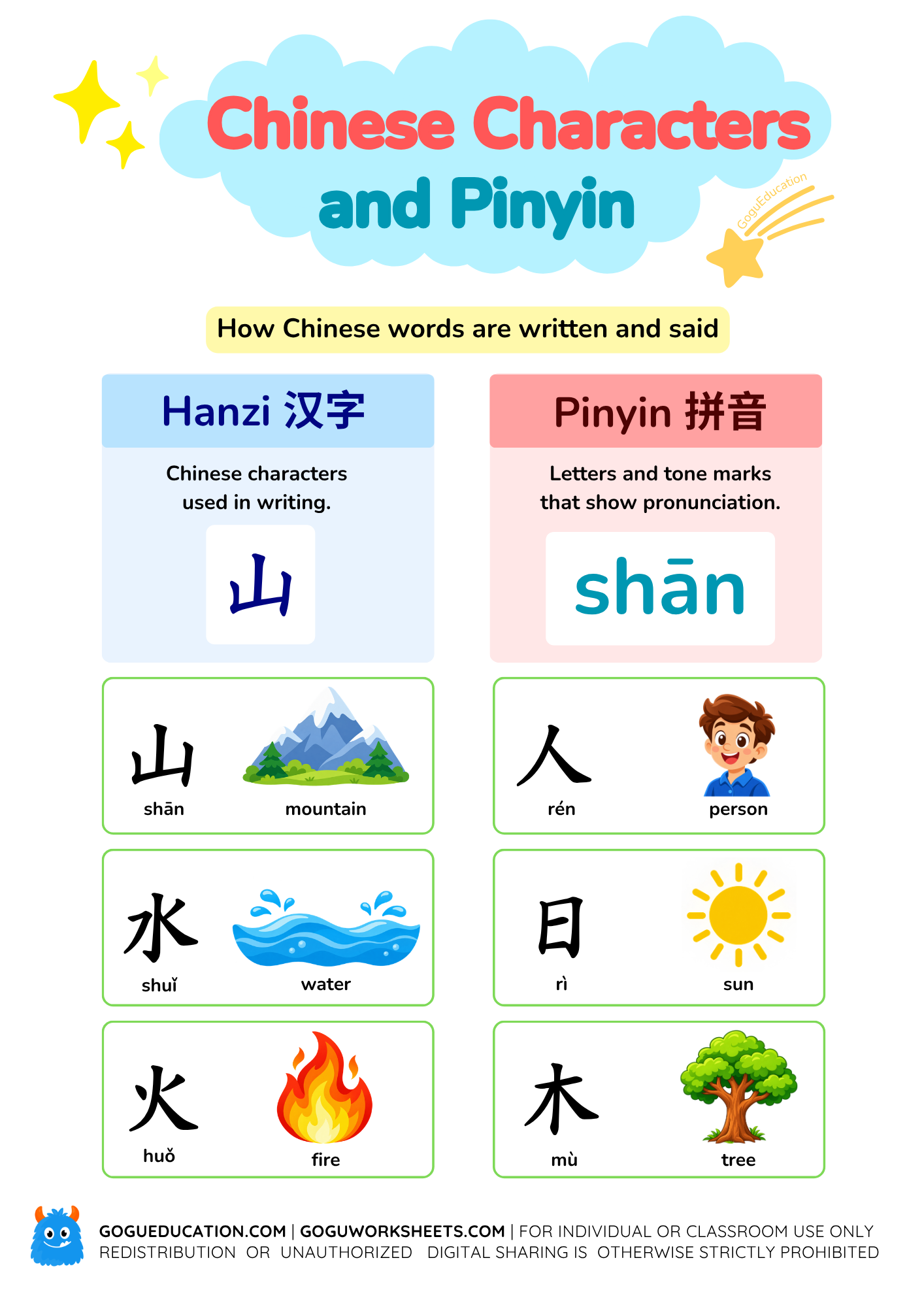
Chinese Characters and Pinyin: Free Printable Poster
How do you read Chinese? Discover the difference between Hanzi (汉字), the characters used to write Chinese, and Pinyin (拼音), the system that helps you learn Mandarin pronunciation. This colourful beginner poster makes Chinese writing easier to understand.
What Are Chinese Characters and Pinyin?
Chinese uses a writing system based on characters rather than an alphabet. Each Chinese character represents a spoken syllable and is associated with meaning. Pinyin is a separate system that uses Latin letters and tone marks to show how Mandarin words are pronounced.
Hanzi (汉字)
Hanzi are Chinese characters. They are used to write Chinese words.
Pinyin (拼音)
Pinyin uses letters and tone marks to help you pronounce Mandarin Chinese.
Both examples above represent the greeting “hello”. Hanzi shows how it is written in Chinese, while Pinyin helps you learn how to say it.
Chinese Characters with Pinyin and English Meanings
Look at these simple Mandarin Chinese examples. Each one includes a Chinese character, its Pinyin pronunciation, and its English meaning.
Frequently Asked Questions About Chinese Characters and Pinyin
Does Chinese have an alphabet?
Written Chinese does not use an alphabet in the same way English does. It uses Chinese characters called Hanzi. Pinyin uses Latin letters to represent Mandarin pronunciation.
What is Hanzi?
Hanzi (汉字) means Chinese characters. These characters are used to write Chinese words. Each character represents a syllable and carries meaning.
What is Pinyin?
Pinyin (拼音) is a system for writing Mandarin Chinese pronunciation with Latin letters. It helps learners read and pronounce Chinese words.
What are the marks above Pinyin letters?
They are tone marks. Standard Mandarin has four main tones and a neutral tone. Tone marks help show the pitch pattern used when pronouncing a syllable.
Should beginners learn Hanzi or Pinyin first?
Beginners often learn Pinyin alongside basic Chinese characters. Pinyin helps with pronunciation, while Hanzi helps develop Chinese reading skills.
Can I print this Chinese learning poster?
Yes. The free PDF is intended for individual and classroom use under the licensing conditions displayed above.
1. Does Chinese Have an Alphabet?
No. Chinese uses written characters called Hanzi (汉字, Hànzì), not an ABC alphabet. Mandarin learners use Pinyin (拼音, Pīnyīn) to see how words are pronounced.
English
Letters combine to make words.
Chinese
Characters are used to write words.
2. What Is Pinyin?
Pinyin uses familiar Latin letters to show Mandarin pronunciation. The letters do not always sound the same as they do in English.
3. Pinyin Initials and Finals
A Mandarin syllable usually has an initial (starting consonant sound), a final (vowel part), and a tone. Some syllables have no initial.
21 Standard Initials (声母, shēngmǔ)
Pinyin also uses y and w as spelling letters.
Finals (韵母, yùnmǔ)
Six simple finals:
More examples:
This is a beginner selection, not every final.
Put the Sounds Together
m + a + ˇ = mǎ
马 (mǎ) = horse
4. Complete Pinyin Syllable Chart
One complete chart: find an initial in the left column and a final across the top. Scroll horizontally to explore all combinations. Blank cells represent combinations not shown in the reference.
| Initial ↓ / Final → | a | o | e | -i¹ | -i² | er | ai | ei | ao | ou | an | en | ang | eng | ong | i | ia | iao | ie | iou | ian | in | iang | ing | iong | u | ua | uo | uai | uei | uan | uen | uang | ueng | ü | üe | üan | ün |
|---|---|---|---|---|---|---|---|---|---|---|---|---|---|---|---|---|---|---|---|---|---|---|---|---|---|---|---|---|---|---|---|---|---|---|---|---|---|---|
| ∅ | a | o | e | er | ai | ei | ao | ou | an | en | ang | eng | yi | ya | yao | ye | you | yan | yin | yang | ying | yong | wu | wa | wo | wai | wei | wan | wen | wang | weng | yu | yue | yuan | yun | |||
| b | ba | bo | bai | bei | bao | ban | ben | bang | beng | bi | biao | bie | bian | bin | bing | bu | ||||||||||||||||||||||
| p | pa | po | pai | pei | pao | pou | pan | pen | pang | peng | pi | piao | pie | pian | pin | ping | pu | |||||||||||||||||||||
| m | ma | mo | me | mai | mei | mao | mou | man | men | mang | meng | mi | mia | miao | mie | miu | mian | min | ming | mu | ||||||||||||||||||
| f | fa | fo | fei | fou | fan | fen | fang | feng | fu | |||||||||||||||||||||||||||||
| d | da | de | dai | dei | dao | dou | dan | den | dang | deng | dong | di | dia | diao | die | diu | dian | ding | du | duo | dui | duan | dun | |||||||||||||||
| t | ta | te | tai | tao | tou | tan | tang | teng | tong | ti | tia | tiao | tie | tian | ting | tu | tuo | tui | tuan | tun | ||||||||||||||||||
| n | na | ne | nai | nei | nao | nou | nan | nen | nang | neng | nong | ni | niao | nie | niu | nian | nin | niang | ning | nu | nuo | nuan | nun | nü | nüe | |||||||||||||
| l | la | le | lai | lei | lao | lou | lan | lang | leng | long | li | lia | liao | lie | liu | lian | lin | liang | ling | lu | luo | luan | lun | lü | lüe | |||||||||||||
| g | ga | ge | gai | gei | gao | gou | gan | gen | gang | geng | gong | gu | gua | guo | guai | gui | guan | gun | guang | |||||||||||||||||||
| k | ka | ke | kai | kei | kao | kou | kan | ken | kang | keng | kong | ku | kua | kuo | kuai | kui | kuan | kun | kuang | |||||||||||||||||||
| h | ha | he | hai | hei | hao | hou | han | hen | hang | heng | hong | hu | hua | huo | huai | hui | huan | hun | huang | |||||||||||||||||||
| j | ji | jia | jiao | jie | jiu | jian | jin | jiang | jing | jiong | ju | juan | jun | ju | jue | juan | jun | |||||||||||||||||||||
| q | qi | qia | qiao | qie | qiu | qian | qin | qiang | qing | qiong | qu | quan | qun | qu | que | quan | qun | |||||||||||||||||||||
| x | xi | xia | xiao | xie | xiu | xian | xin | xiang | xiong | xu | xuan | xun | xu | xue | xuan | xun | ||||||||||||||||||||||
| zh | zha | zhe | zhi | zhai | zhei | zhao | zhou | zhan | zhen | zhang | zheng | zhong | zhi | zhu | zhua | zhuo | zhuai | zhui | zhuan | zhun | zhuang | |||||||||||||||||
| ch | cha | che | chi | chai | chao | chou | chan | chen | chang | cheng | chong | chi | chu | chua | chuo | chuai | chui | chuan | chun | chuang | ||||||||||||||||||
| sh | sha | she | shi | shai | shei | shao | shou | shan | shen | shang | sheng | shi | shu | shua | shuo | shuai | shui | shuan | shun | shuang | ||||||||||||||||||
| r | re | ri | rao | rou | ran | ren | rang | reng | rong | ri | ru | rua | ruo | rui | ruan | run | ||||||||||||||||||||||
| z | za | ze | zi | zai | zei | zao | zou | zan | zen | zang | zeng | zong | zi | zu | zuo | zui | zuan | zun | ||||||||||||||||||||
| c | ca | ce | ci | cai | cao | cou | can | cen | cang | ceng | cong | ci | cu | cuo | cui | cuan | cun | |||||||||||||||||||||
| s | sa | se | si | sai | sao | sou | san | sen | sang | seng | song | si | su | suo | sui | suan | sun |
Tip: Swipe horizontally to view all columns. The labels -i¹ and -i² distinguish the special i sounds in zi/ci/si and zhi/chi/shi/ri. The chart follows the supplied reference and shows syllables without tone marks.
5. Four Mandarin Tones
In Mandarin, changing the pitch of your voice can change a word’s meaning. There are four main tones and a neutral tone.
6. Your First Chinese Words
Look at each character, read its Pinyin, and learn its meaning.
7. Where Should Beginners Start?
Step 1: Learn a, o, e, i, u, ü.
Step 2: Learn common initials: b, p, m, f.
Step 3: Practise the four tones.
Step 4: Learn simple characters and words.
Step 5: Read 你好 (nǐ hǎo) and other short phrases.
Frequently Asked Questions
Does Chinese have an ABC alphabet?
No. Chinese uses Hanzi characters for writing. Pinyin uses Latin letters to show Mandarin pronunciation.
What is the Chinese alphabet called?
People often mean Hanyu Pinyin (汉语拼音) when they say “Chinese alphabet.” Pinyin is a pronunciation system, not the Chinese writing system.
How many letters are in Pinyin?
Pinyin uses Latin letters, with ü for a special vowel sound. Beginners often learn 21 consonant initials, plus y and w spelling forms, and groups of finals.
Is Pinyin the same as Hanzi?
No. Hanzi are Chinese written characters; Pinyin shows how Mandarin words are pronounced.
What should I learn first in Mandarin?
Start with Pinyin sounds and tones, then learn a few useful characters and words together.
Key Takeaways
Hanzi (汉字): Chinese characters used for writing.
Pinyin (拼音): Latin-letter guide to Mandarin pronunciation.
Initials and finals: Parts of Mandarin syllables.
Tones: Pitch patterns that can change meaning.