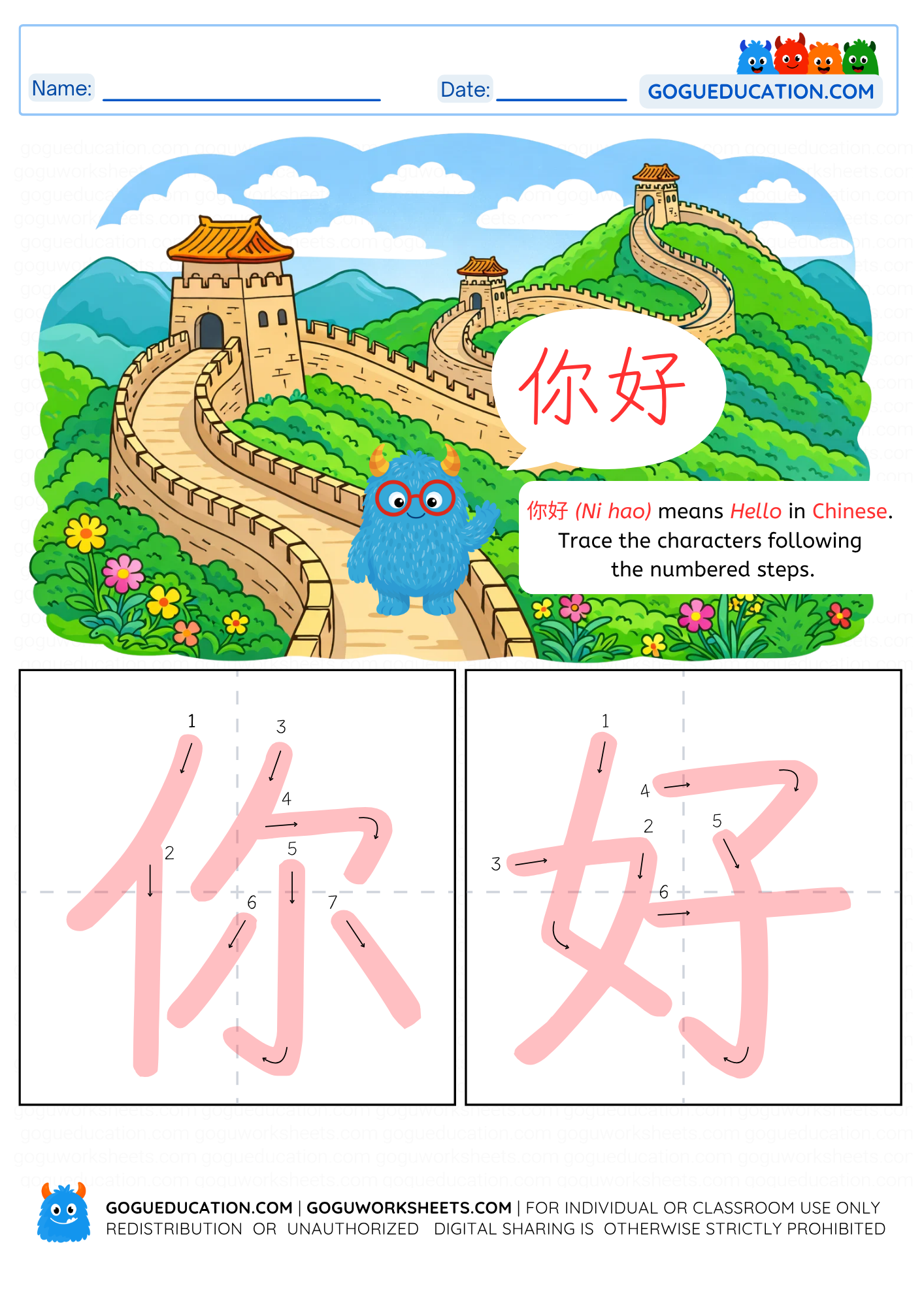
Ni Hao (你好) is the standard greeting in Mandarin Chinese, meaning ‘Hello.’ It consists of two characters: ‘Nǐ’ (you) and ‘hǎo’ (good). Our free Ni Hao tracing worksheet helps beginners master the 13 total strokes required to write this phrase correctly.
汉字笔画顺序 (Stroke Order): 你好
点击播放按钮,观看汉字是如何一步步书写的。
你 (nǐ)
7 画 (Strokes)
好 (hǎo)
6 画 (Strokes)
Master Your First Greeting: How to Write “Ni Hao” (你好)
Welcome to your first step in mastering Chinese calligraphy! Writing is more than just drawing lines; it is about understanding the flow and balance of the characters. Ni Hao (你好) is the most essential phrase in the Mandarin language, and mastering its 13 total strokes will give you a solid foundation for all future learning.
What Does “Ni Hao” Actually Mean?
While we translate it as “Hello,” the literal meaning is much more beautiful:
-
Nǐ (你): You
-
Hǎo (好): Good/Well So, when you greet someone, you are literally saying, “You are good.”
Download Your Free Ni Hao Tracing Sheet
Ready to start? Click below to download our professional Chinese Word Tracing PDF. This worksheet is designed for kids and adult beginners alike, featuring pinyin, stroke-by-stroke diagrams, and plenty of practice space.
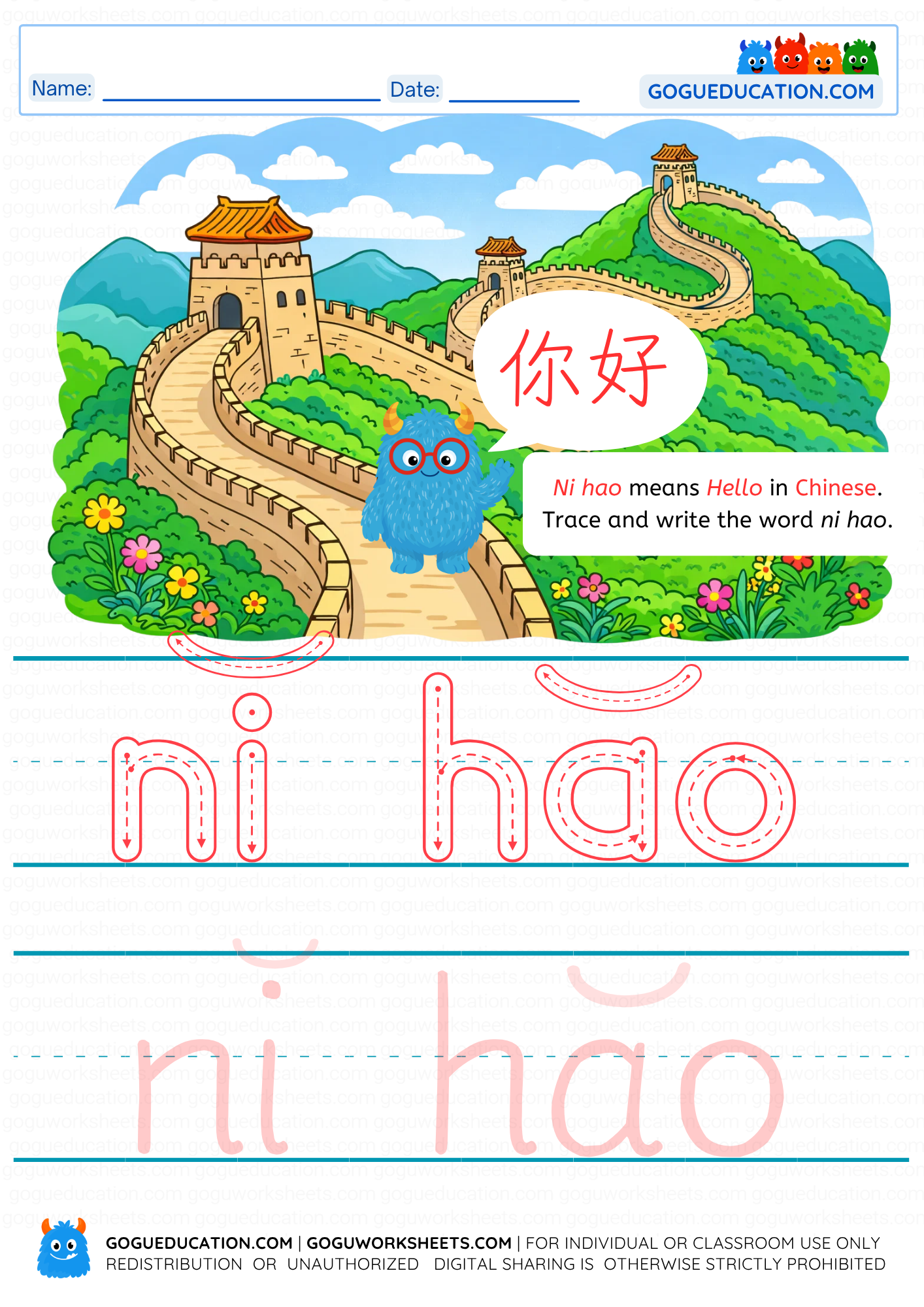
Mandarin Chinese: Ni Hao Tracing Worksheet
Learn to write "Hello" in Chinese! This printable tracing worksheet helps students master the stroke order for "Nǐ hǎo" (你好) while practicing pinyin and character recognition in a structured format.
Action Required
Please accept terms to unlock file
Step-by-Step Stroke Order Guide
In Chinese, the order of the strokes is vital for muscle memory and balance. Follow our printable tracing guide using these rules:
1. Writing Nǐ (你) — 7 Strokes
This character contains the “person” radical (亻) on the left, indicating it refers to a human being.
-
撇 (Piě): Left-falling stroke.
-
竖 (Shù): Vertical stroke.
-
撇 (Piě): Top slanted stroke.
-
横钩 (Héng Gōu): Horizontal stroke with a hook.
-
竖钩 (Shù Gōu): Main vertical hook.
-
撇 (Piě): Small left dot/stroke.
-
点 (Diǎn): Right dot.
2. Writing Hǎo (好) — 6 Strokes
This character is a combination of the radical for “Woman” (女) and “Child” (子). In ancient Chinese culture, having a woman and a child together represented “goodness” or harmony.
-
撇点 (Piě Diǎn): Left-falling dot.
-
撇 (Piě): Left-falling stroke.
-
横 (Héng): Horizontal stroke (completes the ‘Woman’ radical).
-
横撇/弯钩 (Héng Piě/Wān Gōu): The top of the ‘Child’ radical.
-
竖钩 (Shù Gōu): Vertical hook.
-
横 (Héng): Final horizontal bar.
Perfect Chinese Handwriting
-
Balance: Each character should fit into an invisible square. Our Tian Zi Ge (field grid) paper included in the download helps you center your characters perfectly.
-
Pressure: Keep your grip relaxed. Let the pen or pencil flow naturally from top to bottom and left to right.
-
Repetition: Use our Ni Hao tracing worksheet to practice each character at least 20 times to build muscle memory.
How many strokes are in Ni Hao? There are 13 strokes in total: 7 strokes for 你 (Nǐ) and 6 strokes for 好 (Hǎo).
Is “Ni Hao” formal or informal? It is the standard, neutral greeting. If you are speaking to a teacher, boss, or elder, you should use “Nín Hǎo” (您好) to show extra respect.
Why is stroke order important? Correct stroke order ensures the character looks balanced and makes it much easier to write quickly and legibly as you advance to cursive styles.